Precisely sewn on the long belt
Precisely sewn on the long belt
Life-threatening fires are one of mankind's primal fears. Until modern times, fires often reduced entire villages and towns to rubble and ashes. No wonder fire protection plays an important role today. There are strict legal regulations to prevent disasters, not only for new buildings but also for older ones. Escape and rescue routes must be provided, and building and decorative materials must not be highly flammable. In fires, a far greater danger comes from smoke rather than from the fire itself: "Around eighty percent of all fire victims die from smoke," explains Harald Glöckner. He is one of three managing directors of KGG-Brandschutzsysteme GmbH. The Bavarian company from Wallerstein specialises in individually customised fire protection solutions that protect people, material assets and buildings. Its main products include textile smoke and fire protection closures. KGG's production halls produce large smoke and fire protection curtains that limit the spread of smoke in a fire and direct smoke to where it can be extracted. A further effect is the reduction of heat transfer to buildings and components. Together, these measures allow rescue teams to reach the source of the fire, fight it and rescue people trapped by the fire.
Conveyed with pinpoint accuracy
The right place at the right time: this maxim applies not only to good business or outstanding experiences, it also plays an important role in production. In conveyor technology in particular, goods often have to be transported with pinpoint accuracy, as dictated by the cycle time.
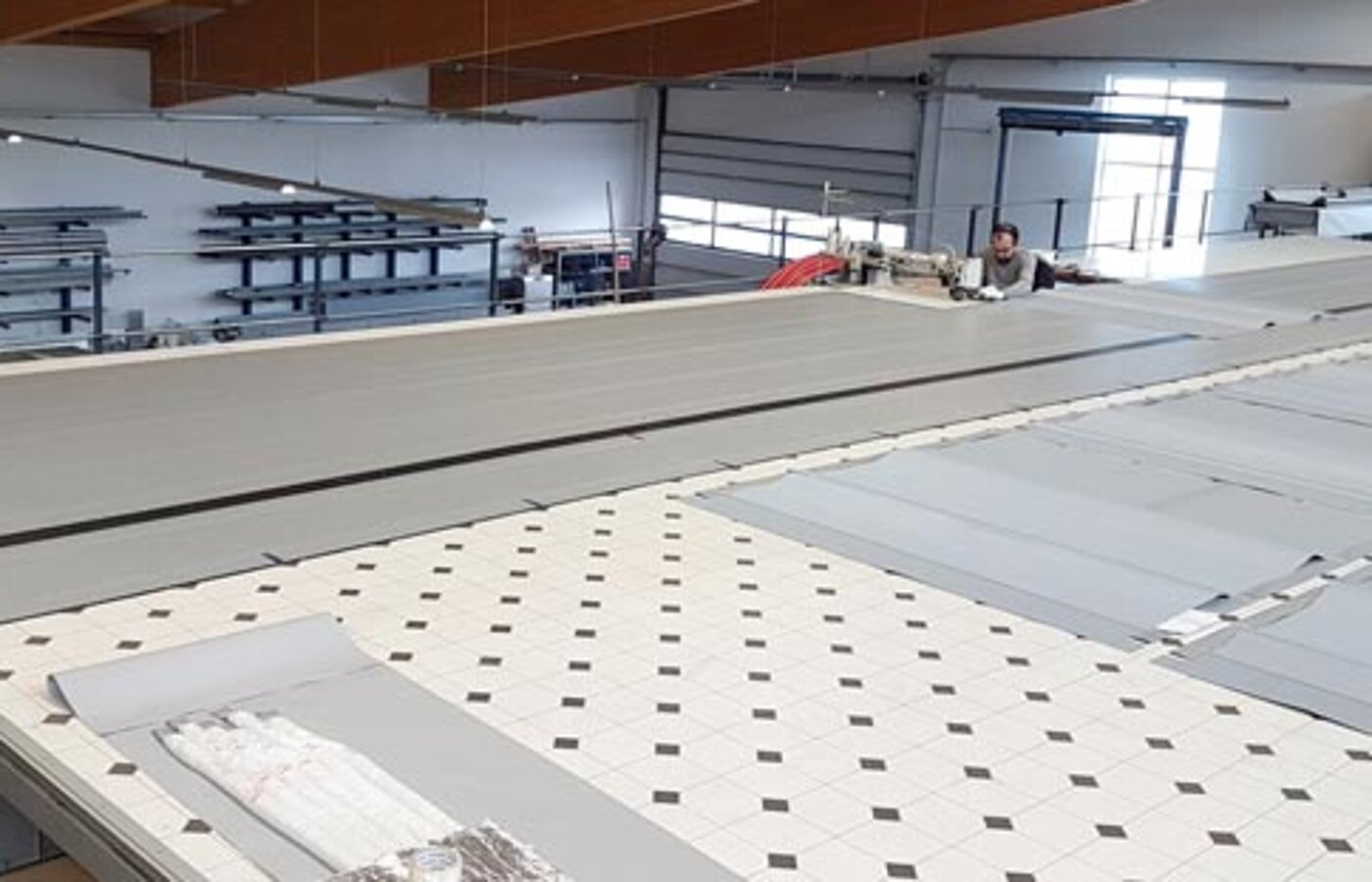
KGG's smoke and fire protection closures consist of special textiles that are sewn together with a precise fit in the company's own production. "There are hardly any off-the-shelf products in this area, so webs about 1.50 metres wide have to be sewn together to the millimetre to form total widths of up to 25 metres," says Glöckner. What this means becomes clear when you look at the finished products: "Our fire and smoke curtains have to adapt to the architectural specifications. They are used in industrial halls, airports, galleries, underground stations, shopping centres and underground car parks, among other places. We offer system heights of up to 20 metres, for example for the façades of high-rise buildings, and system widths of up to 25 metres. With these dimensions, the fire protection curtains are also suitable for closing high façades and wide wall openings, which allows a very open room design. Architects and planners in particular appreciate this," says Glöckner. The curtains can close vertically or horizontally. Even listed buildings can be equipped with them.
Precisely sewn
"A major challenge is the precise sewing of the textile webs. Four years ago, we designed and built our own system for this that meets our high requirements," recalls the managing director, who is responsible for product development and quality assurance. Conveyor technology plays an important role here, because the belts have to transport the textile webs to the sewing machines with pinpoint accuracy. They must arrive exactly in the desired orientation and must not slip. That is why, in addition to the cycle timing, the belt coating also plays an important role. KGG chose Habasit because the market leader is also the only belt supplier that manufactures and offers a full range of fabric and plastic modular belts.
Tailor-made solution
For a specific process step such as handling the textile webs, the belt surface also plays a key role. "At the time, we had many discussions with Habasit technicians to find a solution. It turned out that the HabasitLINK® modular belts of type M2520 with their special coating are better suited to our requirements than fabric belts." HabasitLINK® belts consist of a composite of individual, high-precision injection-moulded plastic modules that are connected to each other by lateral rods. The robust design is optimised for efficient transport and easy cleaning. Thanks to the positive engagement of sprockets and belt, the plastic modular belts make tensioning systems unnecessary and thus ensure permanently correct belt tracking.
When it came to combining and controlling the belts, the technicians recommended an individual configuration: to achieve a transport width of 2,750 millimetres, belt widths of 1,350, 900 and 500 millimetres were combined and synchronised in the drive by a shaft. This created a very large transport and processing area. All the necessary accessories such as sprockets, flights and guide rails also come from Habasit and are specially matched to the modular belts.
After around four years in continuous operation, Managing Director Glöckner draws a positive conclusion: "We invested more in the modular belts than in cheaper fabric belts, but it was worth it. The HabasitLINK® belts have been running without failure or maintenance since commissioning. We transport around 50,000 metres of textile webs on them every year and are very satisfied with the precise transport. Another production line with Habasit belts is currently being planned."
Large webs are sewn together in the production halls and conveyed with pinpoint accuracy on HabasitLINK® modular belts of type M2520.
Source (in German): http://highlights.habasit.ch/2018-02/exakt-genaht-am-langen-band/