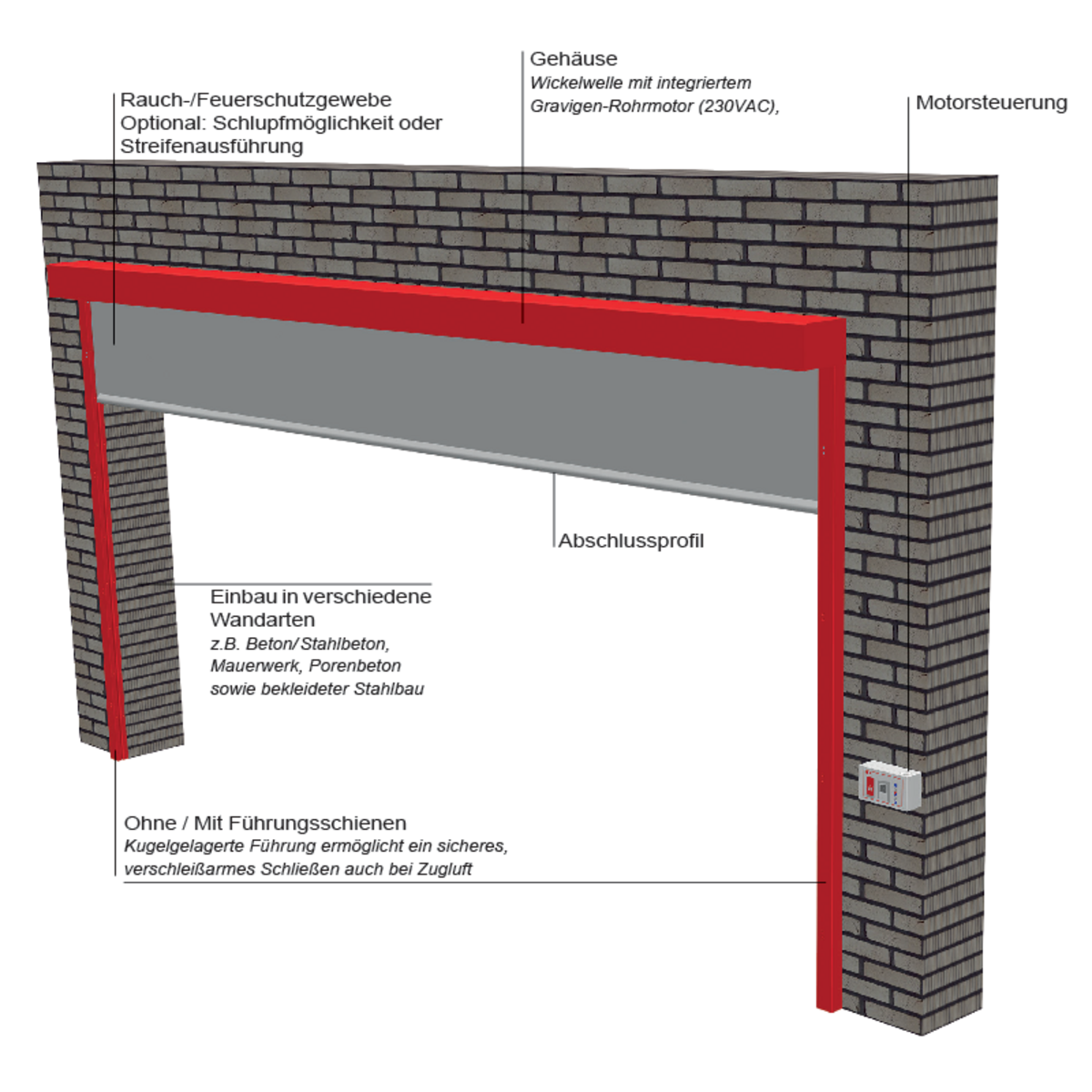
The textile-flexible fire protection closure (TFF) is used to protect parts of buildings against the passage of smoke and fire (E). In addition, heat radiation can be reduced by means of a special fabric (EW).
In 2017, using wood as a raw material, we created a new product line that also meets the insulation requirement (EI) in addition to the criteria mentioned above. Since 01.11.2019, our former product textile-flexible smoke protection closure (TFRA) has been supplied as textile-flexible fire protection closure (TFF) with the classification suffix Sa or S200.
To be able to cover all applications, the TFF is available in the following variations:
- TFF-S
- TFF-E-(S): class E30 to E180, EW20
- TFF-EW-(S): class EW20 to EW90
- TFF-EI: class EI30 to EI60
- TFF-EI-ALL
- TFF-H: class E30 to E90, EW20 to EW90 (horizontal)

TFF-E
Class: E30 - E180, EW20
Goals for protection:
- Preventing the spread of flames
- Partitioning rooms (vertically)

TFF-EW
Class: EW20 - EW90
Goals for protection:
- Preventing the spread of flames by reducing heat transfer
- Partitioning rooms (vertically)

TFF-EI
Class: EI30 - EI60
Goals for protection:
- Insulation and preventing the spread of flames
- Partitioning rooms (vertically)

TFF-H
Class: E30 - E90, EW20 - EW90
Goals for protection:
- Preventing the spread of flames by reducing heat transfer
- Partitioning floors (horizontally)
Goals for protection
Fire and smoke protection closures reliably separate fire compartments and keep fire and smoke where they originate.
- Preventing the spread of flames
- Reducing heat transfer (EW)
- Insulation against heat radiation (EI)
- Partitioning rooms vertically
- Partitioning floors horizontally (TFF-H)